Friday, September 20, 2013

Another Refreshed Royal

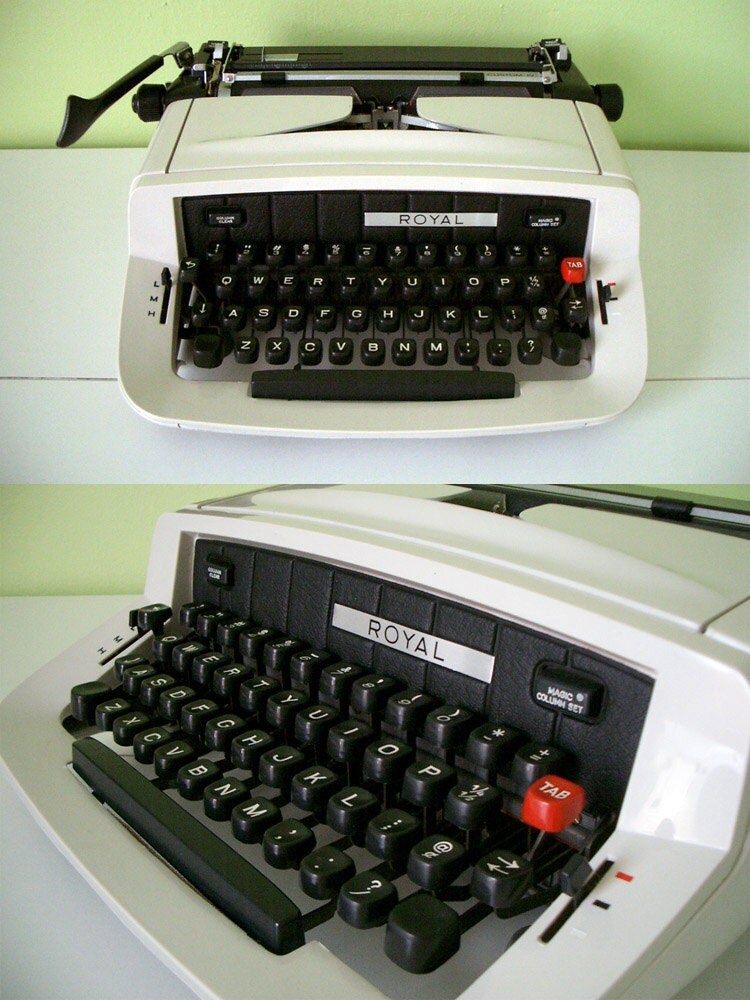
With any luck, my Quiet Deluxe will turn out as well as this red Custom II that I did recently. (I know that it will be as high-quality, but I doubt that I will have as much luck in matching the color. I personally think that the Quiet Deluxe was made to be a two-tone typewriter.)

For some strange reason, Royal never made a two-tone Quiet Deluxe. There were two-tone Aristocrats. Early  boxy Quiet Deluxes were two-tone, as well as the gold-plated models. Here's Ian Fleming's typewriter

Thursday, September 12, 2013

Refreshed Red Royal

When I bought this Royal Custom II in November, 2012, the paint was very rough. Here is a picture from November, 2012. Notice how dark and chipped the old paint was. I was able to find an identical color, with a built-in primer. This new paint was much better quality than the original paint, which was not primed. The best part is that it is a perfect match!
As it looked when I bought it.

As it looks now.
I painted everything except the carriage and the plastic parts. 
The color is called Cherry Red.

The lower parts were painted. The carriage was not--it is a perfect match--notice the area behind "Royal."
The basic design of this typewriter became the Royal Precision Portables--the Royal Sabre and Royal Custom III. The Royal Sabre was introduced in 1969, and continued in production, unchanged, until 1981. The Custom III continued until 1977, when it was replaced by the Royal Custom IV.
Royal Custom IV. Notice the dark carriage, and dark keytops. Also, notice the shape of the keytops, and the printing on them. This typewriter was made by Messa of Portugal. 
This typewriter is essentially a more streamlined Royal Futura, which dates back to 1958. Mechanically, the basic design dates back to 1927, when the first Royal Portable entered the market. The design was improved over the years, with the following features:
  • Royal begins making typewriters--1906
  • First Royal Portable introduced--1927
  • Ribbon enclosed--1930
  • Hinged "Duo-Case" carrying case--1930
  • Tabulator--1930 (optional on some models) [Portable 2]
  • Touch Control--1934 [Model O]
  • Segment Shift--1939 [Quiet De Luxe]
  • Synthetic plastic carriage knobs--1939 [Quiet De Luxe]
  • Magic Margin on both sides--1948 [Quiet De Luxe]
  • Touch Control hidden under the ribbon cover--1948 [Quiet De Luxe]
  • Tweed-covered Fiberglass Carrying Case--circa 1949 [Quiet De Luxe]
  • Plastic Keytops--1951. [Quiet De Luxe]
  • Push-button Magic Margin--1951 [Quiet De Luxe]
  • Line Meter--1953 [Quiet De Luxe]
  • Push-button ribbon cover--1953 [Quiet De Luxe]
  • Dual-anchor carrying case with cleat--1955 [Quiet De Luxe]
  • Addition of "1/!" and "=/+" keys--1957 [Quiet De Luxe]
  • Twin-Pak Ribbon--1957 [Quiet De Luxe]
  • Easy-change ribbon guide--1957 [Quiet De Luxe]
  • Keyset tabulator--1958/1959 [Futura]
  • Ribbon Color selector hidden--1958/1959 [Futura]
  • Paper bail removed on most models--1962 [Safari]
  • Longer carriage knobs--1962 [Safari]
  • Saddle-grained molded plastic carrying case--1962 [Safari]
  • "Swing-Away" Handle--1962 [Safari]
  • "Magic Meter" (plastic ruler on the front of the carriage, with holes for a pencil--for making tables)--1962 [Safari]
  • Lift-Off Ribbon Cover --1962 [Safari]
  • Touch-Control moved to keyboard--1962 [Safari]
    • Touch Control now has three positions
  • Ribbon Color Selector moved to keyboard--1962 [Safari]
  • Molded Plastic front panel--1962 [Safari]
  • Vinyl Carriage-Return lever--1965 [Custom]
  • Paper-Bail reintroduced on Custom Series--1965 [Custom]
  • Rubber decorative panel--1967 [Custom II]
  • Plastic carriage ends--1967 [Custom II]
  • Plastic body-side panels--1972 [Sabre]
  • Carrying case squared-off--1972 [Sabre]
  • Production moved to Portugal--1972 [Sabre, Custom III]
  • Keytops become square--1979 [Custom IV, Sabre]
  • Full-size Royal Portable production ends--circa 1982 [Custom IV, Sabre] 


Wednesday, September 11, 2013

1950-model Smith-Corona Silent

On September 19, 1949, Smith-Corona ran a full-page ad in Life Magazine advertising the "new 1950 Smith-Corona Portable." Advertised as having "the touch and action of an office typewriter," the new portable sold so well, that it was not discontinued until 1960. The keyboard, which lacked metal rims, was called the "Colorspeed" keyboard, partly due to the different color of the function (backspace, shift, shift-lock, margin-release, and tabulator) keys. Later models were available in many bright colors, with white keys. (The Silent and Super models became the Silent-Super in 1954. The colorful versions are either Silent-Supers, or Sterlings. The Sterling model continued with this design until 1962--the ribbon cover was slightly modified for 1964-1966, and was dropped for the 1967 model year.) These typewriters are incredibly well-made, and if a key is disconnected, it can be fixed with minimal effort with a mechanical pencil, or a small screwdriver. The arm that connects the keys with the typebars was intentionally designed to be easy to reconnect. The arm has a hinged pin that can be moved to realign, and then put into place. This feature started on the 1950 model, and continued until the end of Smith-Corona manual typewriter production in 1983. It only applies to the full-size models.
From Life , September 19, 1949.

A well-used, yet well-preserved example of the 1950 Smith-Corona Silent

Another view of the 1950 Smith-Corona. Notice the six stripes on the ribbon cover. These can be found on certain Skyriters, and the Silent, Super, and most Silent-Super models.
A 1954 photo of an office-machine display at H.D. Baker Business Machines,
in Tacoma, WA (Image Courtesy of Tacoma Public Library)

H.D. Baker's new home, Tacoma, WA, 1955

Monday, September 9, 2013

Cole-Steel's Page-End Indicator

For two months, I have been trying to figure out the Page-End Indicator on my Cole-Steel portable typewriter. I began to explore sites written about the ABC and Cole-Steel portable typewriters (the ABC was the European name for the Cole-Steel) When I found this instruction page on Will Davis' site, I was ecstatic, and amazed at how truly simple the Page-End Indicator on the Cole-Steel truly is. (It is so simple that it is difficult.)
The German instructions for the Page-End Indicator
(originally from Davis Typewriter Works, davistypewriters.blogspot.com)
This diagram shows three sizes of paper (A4--roughly 8 1/2 x 11 inches, A5--roughly 8 1/2 x 5 1/2 inches, and A6 paper, which is smaller. These sizes correspond to the shapes on the right carriage knob of the Cole-Steel. Here are approximate instructions for using the page-end indicator:
  1. Line up the arrow with the rectangle that matches the size of your paper--the long rectangle is for Letter size, the smaller size is for Statement (1/2 letter).
  2. Insert paper into the carriage.
  3. When the rectangle for letter appears for the third time, you are at the end of the page. Remove the paper, and repeat steps 1-3 for each additional page.

Friday, September 6, 2013

Sears Typewriter Ads, 1961-1962

The Seattle Times, September 28, 1962 (Image from America's Genealogy Bank) 

The Seattle Times, September 7, 1961  (Image from America's Genealogy Bank) 
The Seattle Times, October 18, 1962  (Image from America's Genealogy Bank) 

Thursday, September 5, 2013

New case for an Olivetti Lettera 22

This case looks brand-new. Notice the lack of wear on the handle. 


I think that this case is for an older Lettera 22, notice how small the zippers are.

I put the red casing on my 1956 Lettera 22, and its casing onto this one. 
This is the manual that came with this 1957 Olivetti Lettera 22. On the back, the original owner stamped the name "JUDY", twice.

Monday, September 2, 2013

1959 Smth-Corona Skyriter and a Hypothesis

If I had to pick a favorite typewriter, there is a good chance that it would be this one:
This typewriter was manufactured in 1959. It is one of the last American-made Smith-Corona Skyriters; later ones were made in Great Britain.
 Notice that this typewriter has the longer carriage-return lever. This can be found on the Corsair series as well.
 Like most Skyriters, a large amount of paint had rubbed off of the space bar. I repainted the space bar in a color that perfectly matches the case of this typewriter.
 This typewriter even had the original manual! And the brush!
There were ten Smith-Corona dealers in Seattle in 1961
  • Burt Typewriter, 1204 Second Avenue, Seattle
  • Clark Stationery Company, 12750 Bothell Way (now Lake City Way), Seattle
  • Foster Office Equipment, 457 SW 153rd, Burien
  • Gene Brown Typewriter, 5511 24th Avenue NW, Seattle
  • Lowman & Hanford, 1515 Second Avenue, Seattle
  • MacDougall & Southwick, Second and Pike (Now a parking lot behind City Target), Seattle
  • Record Stationery and Office Supply, 801 Walla Walla Avenue, Seattle
  • Tom's Typewriter and Hobby Shop, 3402 Claremont Avenue South, Seattle
  • University Book Store, 4326 University Way NE, Seattle
  • Washington Book Store, 4316 University Way NE, Seattle (Now part of the University Book Store
These dealers were sourced from a Seattle Times advertisement. All of these dealers sold Smith-Coronas in 1959 as well. Because the typewriter is unmarked, I am guessing that it was not sold by a typewriter shop, but rather a department store. However, most typewriter dealers in Seattle did not bother to label compact typewriters. (I have seen a report of a Royalite that was sold by Burt Typewriter that did not have a label, but came with a receipt.) Burt Typewriter was a very high-volume Smith-Corona dealer. Since this typewriter was purchased directly across the King County Line, in Edmonds (barely), I am guessing that it may have been sold in the North End, or Downtown. If this is true, it removes Foster Office Equipment (who labeled all typewriters), Tom's Typewriter and Hobby Shop, and Record Stationery and Office Supply. Lowman and Hanford put metal labels on the cases of the typewriters that they sold (the two labels said "L" and "H".) Since there is no label on the case, I can probably rule out Lowman and Hanford. MacDougall and Southwick was on its last legs by 1959, partly because of its out-of-the-way location. This does not rule it out, but the odds are against it. That leaves Burt Typewriter,  Clark Stationery, Gene Brown, and the two UW Bookstores (Washington Book Store was separate from the University Book Store.) The University Book Store labeled the typewriters that they sold, leaving Burt Typewriter (possibly), Clark Stationery (very likely), Gene Brown, and the Washington Book Store. Gene Brown was located in a relatively out-of-the-way location in Ballard. Both the Washington Book Store and Clark Stationery were located on very main streets (University Way, better known as "The Ave," and Lake City Way, respectively.) This typewriter was very well cared-for, and had the manual and the brush, making me think it belonged to an older person. (I think if a college student had used it, the case would be more scuffed, and the typewriter would be more worn-out, due to use.) I think that this typewriter was a prized possession--the case shows very little wear, there was only minor paint loss on the space bar, and there is only one chip out of the finish, caused by the carriage-return lever. The Skyrier was the bottom of the Smith-Corona line. As a result, these typewriters were often used as second typewriters, or for students. I think that someone saved every penny to buy this typewriter--it is a very clean machine, requiring no lubrication or cleaning. (This was true when I bought it, too.) The ribbon was slightly dry when I bought it (I have replaced it with a better one, but kept the original as a backup) The case was remarkably clean--there was only a small amount of dust.